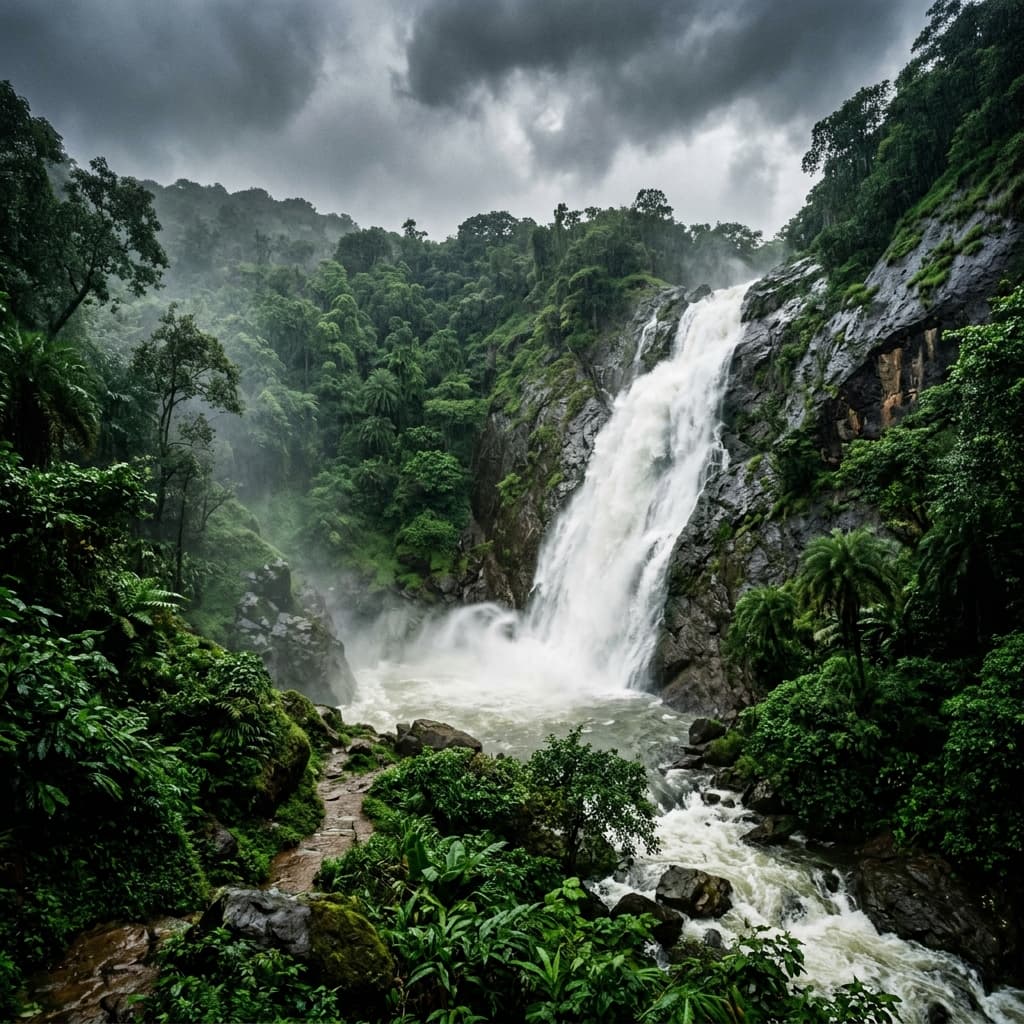
Between June and September, something happens in the Western Ghats above Goa that most visitors never see. The landscape transforms. Dry riverbeds become torrents. Rocky outcrops become curtains of white water. Trails that are dusty in April are running knee-deep in clear mountain water by July.
This is the Goa that doesn't make it to the Instagram feeds — because to find it, you have to be willing to get seriously wet.
Dudhsagar Falls
Goa's most famous waterfall needs no introduction, but it deserves a better one than most guides give it. At 310 metres, Dudhsagar is one of the five tallest waterfalls in India. In the monsoon, at full flood, it is genuinely awe-inspiring — a four-tiered curtain of white water that earns its name (Dudh = milk, Sagar = ocean) emphatically.
Getting There
The falls sit on the Goa-Karnataka border within the Bhagwan Mahavir Wildlife Sanctuary. Access is controlled by the Forest Department.
From Mollem (most common route):
- Book a Forest Department jeep from Mollem National Park entrance — jeeps depart in organized batches
- 45-minute jeep ride to the falls, followed by a 20-minute walk
- Swimming at the base pool is permitted during the jeep tour
On foot (for the serious):
- The trek from Kulem Station (on the Vasco-Londa railway line) is 14km one-way through dense forest
- Requires a guide and Forest Department permit — do not attempt solo
- Duration: 4–5 hours each way
- Best done: Late June to August, when the waterfalls are at maximum volume but the trails are still passable
What Nobody Tells You
The jeep tour pools stop at a viewing distance. If you want to actually stand at the base of the falls — close enough to feel the spray, close enough that the sound is physical — you need to do the walk. It is entirely worth it.
Warning: The Dudhsagar trek is closed intermittently during heavy monsoon. Always check current Forest Department advisories before planning. Flash flooding in the ravines can be sudden and dangerous.
Tambdi Surla and the Temple Approach
The Tambdi Surla Mahadeva temple — the oldest surviving temple in Goa, built in the 12th century — sits beside a mountain stream in the Bhagwan Mahavir sanctuary. During the monsoon, the stream that runs past the temple becomes a proper waterfall about 2km upstream.
The walk from the temple through the forest to the cascade takes 45 minutes on a marked trail. Temple, jungle, and waterfall noise — and almost nobody on the path on a weekday.
Savari Waterfall (South Goa Interior)
Lesser known and harder to reach, Savari requires a drive into the Quepem or Sanguem interior and then a 20-minute hike through cashew and rubber plantations. The fall itself is modest — perhaps 30 metres — but the pool at its base is wide, deep and cold, and you will almost certainly have it entirely to yourself.
This is the kind of place locals bring their families on weekend afternoons in July. No signboards. No facilities. Just a waterfall.
Harvalem (Arvalem) Falls
Harvalem is Goa's most accessible monsoon waterfall — situated in Sanquelim in North Goa, reachable by road, with a paved viewpoint area. It is not the most spectacular, but it is the only one that can realistically be visited on a half-day trip from North Goa without significant trekking.
Adjacent to the falls is the Harvalem Rock Cut Caves — 6th-century Shiva temples carved directly into a laterite outcrop. Worth 45 minutes.
How We Organise Waterfall Experiences
Our monsoon adventure package builds itineraries around the waterfall season, combining Dudhsagar (trek, not the jeep tour) with a Tambdi Surla morning, a Savari afternoon, and nights at a jungle property in Molem that puts you deep inside the sanctuary.
Transport, Forest Department permits, and a local guide who knows these trails intimately are all included. The guide matters more than you might think — the trails are unmarked, the terrain is slippery, and several paths that seem obvious lead to difficult terrain.